The Clinical Biochemistry Department is a basic sciences department within the College of Medicine, King Khalid University. It teaches clinical and applied biochemistry to students in Medicine, Dentistry and Pharmacy at undergraduate and postgraduate levels. Faculty members conduct research in clinical biochemistry, molecular biology and genetic engineering.
Vision
The department strives for excellence in teaching, medical research and community service, drawing on the expertise and research of its faculty.
Mission
To prepare graduates with strong scientific knowledge and laboratory skills, enabling them to understand biochemical and biological processes in the human body in health and disease and to keep pace with advances in medical and health sciences.
Goals
- Effective teaching of the theoretical and practical aspects of clinical biochemistry and related biomedical disciplines to students in Medicine, Dentistry and Pharmacy.
- Active participation in conducting research concentrating on studying clinical topics, community health problems, and endemic diseases, at national, regional, and international levels.
- Publication of the results of research in local, regional and international periodicals, and presenting them at conferences.
- Departmental participation in fields of community service and environment.
- Performing general, specialized, and confirmatory diagnostic laboratory tests.
The department teaches MBC226 and MBC227 and MBC534 courses for the MBBS program. In addition, the department teaches biochemistry courses for the Pharmacy [MBC223 MBC228] and Dentistry [MBC224 MBC225] colleges.
Department Committees
The Department, represented by its teaching staff members, has been participating in several committees of the College and the University, as well as forming a number of permanent and temporary committees at the Department:
1. College and University level:
· College Academic Affairs Office
· College Academic Guidance Committee
· College Postgraduate Studies Committee for Basic Sciences
· College Stem Cell Research Committee
· College Research Ethics Committee
· Committee for preparing a biostatistics curriculum for postgraduate students at the faculty’s basic sciences departments
· Committee for organizing the College's Annual Scientific Research Day event
· College E-learning Committee
· Committee for developing the University's Website
2. Department level:
· Academic Timetable Preparation
· Curricula Evaluation Committee
· Scientific Research Committee
· Teaching Staff Member Promotion Committee
· Committee for Auditing and Revising Examination Results
· Committee for the Master's Degree in Clinical Biochemistry
· Committee for looking at ways to bring Saudis with competencies to work at the Department.
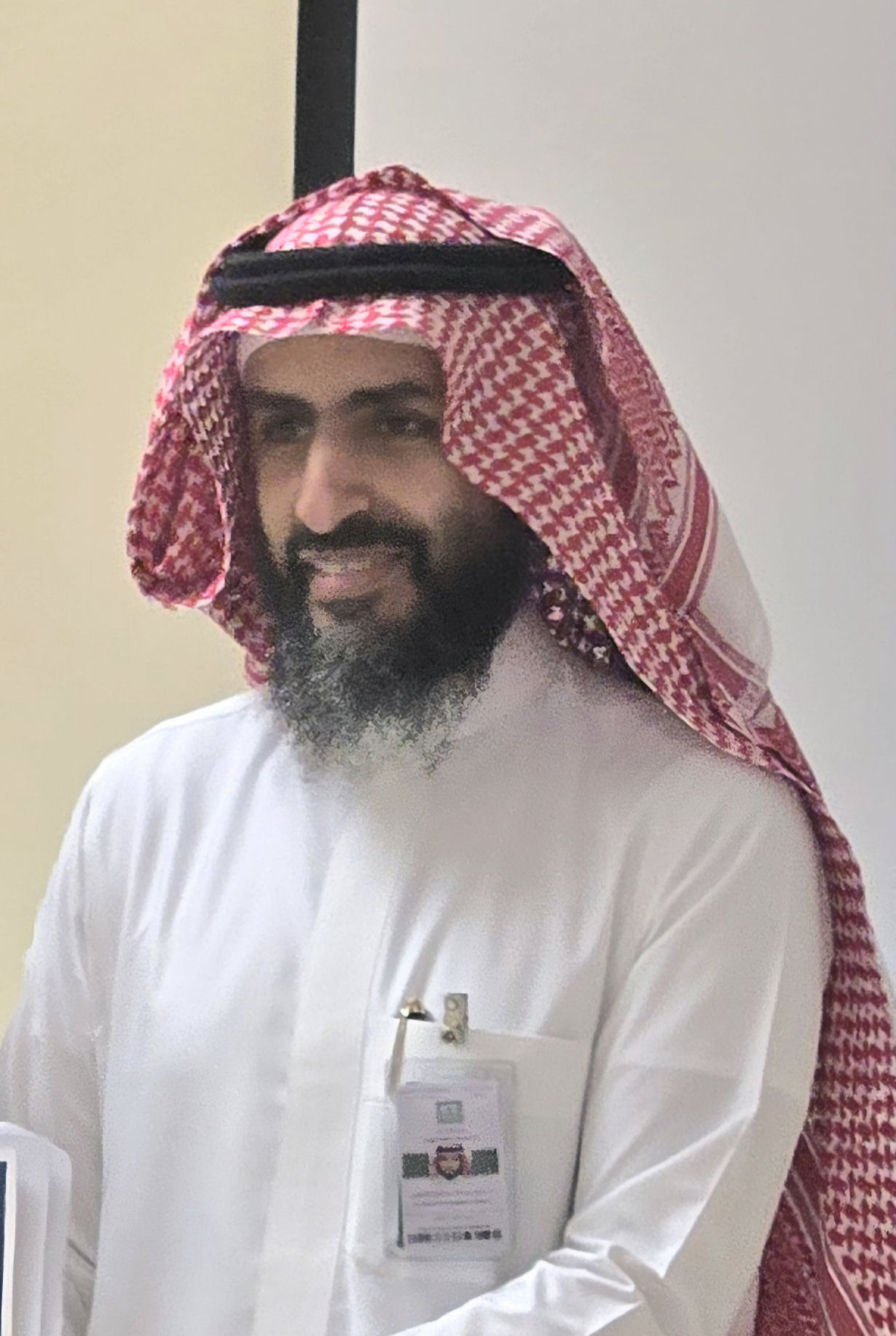
Dr Muhammed Alshehri
Consultant in Internal Medicine and Nephrology
College of Medicine
Department of Clinical Biochemistry
P.O. Box: 641, Abha
Office extension: 7991
Email: maabdulaziz@kku.edu.sa
Qualifications and Professional Roles
- Consultant in Internal Medicine and Nephrology
- American Board Certified in Internal Medicine and Nephrology
- Head of the Academic Office at the College of Medicine
- Member of the Institutional Review Board (IRB) Committee for Saudi German Hospital - Aseer
- Member of the Nephrology Fellowship Training Program at Aseer Central Hospital
Programs and Courses
The department teaches the following courses to students in the colleges of Medicine, Dentistry and Pharmacy.
1. Traditional Curriculum — College of Medicine
Scroll horizontally to view all columns when needed.
| SN | Course Name | Course Code | Level | Credit Hours |
|---|---|---|---|---|
| 1 | Biochemistry 1 | MBC 226 | L3 | 4(3+1) |
| 2 | Biochemistry 2 | MBC 227 | L4 | 4(3+1) |
| 3 | Applied Molecular Medicine | MBC 534 | L10 | 2(2+0) |
2. Integrated Curriculum — Department Coordination
Scroll horizontally to view all columns when needed.
| SN | Course Name | Course Code | Year | Credit Hours |
|---|---|---|---|---|
| 1 | Metabolism and Nutrition | MBC2371 | 2 | 4 |
| 2 | Molecular Medicine | MBC3273 | 3 | 2 |
| 3 | Endocrine System | END 3672 | 3 | 8 |
| 4 | Human Genetics (Elective) | GEN 4235 | 4 | 2 |
3. Integrated Curriculum — Shared Teaching
Scroll horizontally to view all columns when needed.
| SN | Course Name | Course Code | Year | Credit Hours |
|---|---|---|---|---|
| 1 | Essential Foundation Course-1 | FOU 2451 | 2 | 5 |
| 2 | Growth and Development | GRD 2352 | 2 | 4 |
| 3 | Musculoskeletal & Integumentary Systems | MUS 2653 | 2 | 8 |
| 4 | Gastrointestinal System | GIT 2654 | 2 | 8 |
| 5 | Cardiovascular System | CVR 2681 | 2 | 8 |
| 6 | Reproductive System | GNT 3683 | 3 | 8 |
| 7 | Renal System | REN 3684 | 3 | 10 |
| 8 | Hematopoietic & Lymphatic Systems | HEM 3752 | 3 | 8 |
| 9 | Neuroscience & Special Senses | NES 3655 | 4 | |
| 10 | Training & Career Preparation Skills | COMM 0401 |
4. Courses for Dentistry and Pharmacy Students
Scroll horizontally to view all columns when needed.
| SN | College | Course Code | Level | Credit Hours |
|---|---|---|---|---|
| 1 | Pharmacy | MBC 223 | L3 | 3(2+1) |
| 2 | Pharmacy | MBC 228 | L4 | 3(2+1) |
| 3 | Dentistry | MBC 224 | L3 | 3(2+1) |
| 4 | Dentistry | MBC 225 | L4 | 3(2+1) |
Staff and Faculty
Male Staff
Scroll horizontally to view all columns when needed.
| Name | Nationality | Academic Rank | Office extension | KKU Username | Professional profile |
|---|---|---|---|---|---|
| Muhammed Abdullah AlShehri | Saudi | Assistant Professor (HOD) | 7991 | maabdulaziz | |
| Mohamed Abd Ellatif | Egyptian | Professor | 7865 | mabdellatif | |
| Waleed Niazy Hassan | Egyptian | Professor | 7867 | wnhassan | |
| Salah Ahmed Sheweita | Egyptian | Professor | 7867 | ssheweita | |
| Khalid Ali Nasif Mohamed Ismail | Egyptian | Associate Professor | 8472 | kismail | |
| Mohammed Amanullah | Indian | Associate Professor | 7863 | maman | |
| Ayaz Khurram Mallick | Indian | Associate Professor | amallick | ||
| Ayyub Ali Patel | British UK | Associate Professor | 7870 | ayyub | |
| Imad M. Al-Ghawanmeh | Jordanian | Lecturer | 8295 | alghawanmeh | |
| Mohammed Babiker Abdelrouf | Sudanese | Assistant Professor | 4427 | mbabkr |
Female Staff
Scroll horizontally to view all columns when needed.
| Name | Nationality | Academic Rank | Office extension | KKU Username | Professional profile |
|---|---|---|---|---|---|
| Rehan Munir Youssif Soliman | Egyptian | Associate Professor | 2513 | rsoliman | |
| Noora Saeed Khamees Al Zahrani | Saudi | Assistant Professor | 2513 | nalzahrani | |
| Muniera Yousif Mohi Eldeen | Sudanese | Lecturer | 2513 | myousof | |
| Marwa Esmaeel Saeed | Sudanese | Lecturer | 2513 | misaeed | |
| Safa Hassan Umer | Sudanese | Lecturer | 2513 | shasn |
Research
Research underpins academic knowledge and deepens understanding within each field. The Clinical Biochemistry Department contributes to a range of research areas.
Selected Publications
- Al Humayed SM, et al. (2020). Clinical and Biochemical Predictors of Nonalcoholic Fatty Liver Disease among Type 2 Diabetes Mellitus Patients at Primary Health Care Level in South Western Saudi Arabia. Diagnostics, 10(10), 809. https://doi.org/10.3390/diagnostics10100809
- Elgadir TA, et al. (2024). In-silico and in-vitro studies revealed alpha-amyrin as a potent inhibitor of TLR2 for the therapeutics of bacterial infection and sepsis. Cellular and Molecular Biology, 70(6), 97-107. https://doi.org/10.14715/cmb/2024.70.6.16
- Basiouny El-Gamal B, et al. (2024). Pulsatillic acid as a potential inhibitor of protein kinase C-alpha in non-small cell lung cancer. Cellular and Molecular Biology, 70(7), 49-57. https://doi.org/10.14715/cmb/2024.70.7.7
- Chen YK, et al. (2024). The role of mesenchymal stem cells in the treatment and pathogenesis of psoriasis. Cytokine, 182, 156699. https://doi.org/10.1016/j.cyto.2024.156699
- Tarique M, et al. (2025). Structural dynamics of PCSK9 loss-of-function variants: implications for LDL cholesterol regulation and cardiovascular risk. Cellular and Molecular Biology, 71(12), 126-138. https://doi.org/10.14715/cmb/2025.71.12.15
- El Henafy HMA, et al. (2025). Impact of gold nanoparticle exposure on the development pancreas and kidney: Dose-dependent;oxidative stress; miRNA expression and Nrf2/ARE Signalling. International Immunopharmacology, 152, 114409. https://doi.org/10.1016/j.intimp.2025.114409
- Mir MM, et al. (2026). Natural Products in Prostate Cancer: Crosstalk Among the Gut Microbiome, Androgen Receptor Signaling, and Epigenetic Regulation. International Journal of Molecular Sciences, 27(13), 5956. https://doi.org/10.3390/ijms27135956
Community Services
The department's role extends to participation in community service and public health education programs and seminars, as well as participation in academic seminars in secondary schools to provide professional medical information.
The department also welcomes junior high school students and familiarizes them with the parts of the human body.
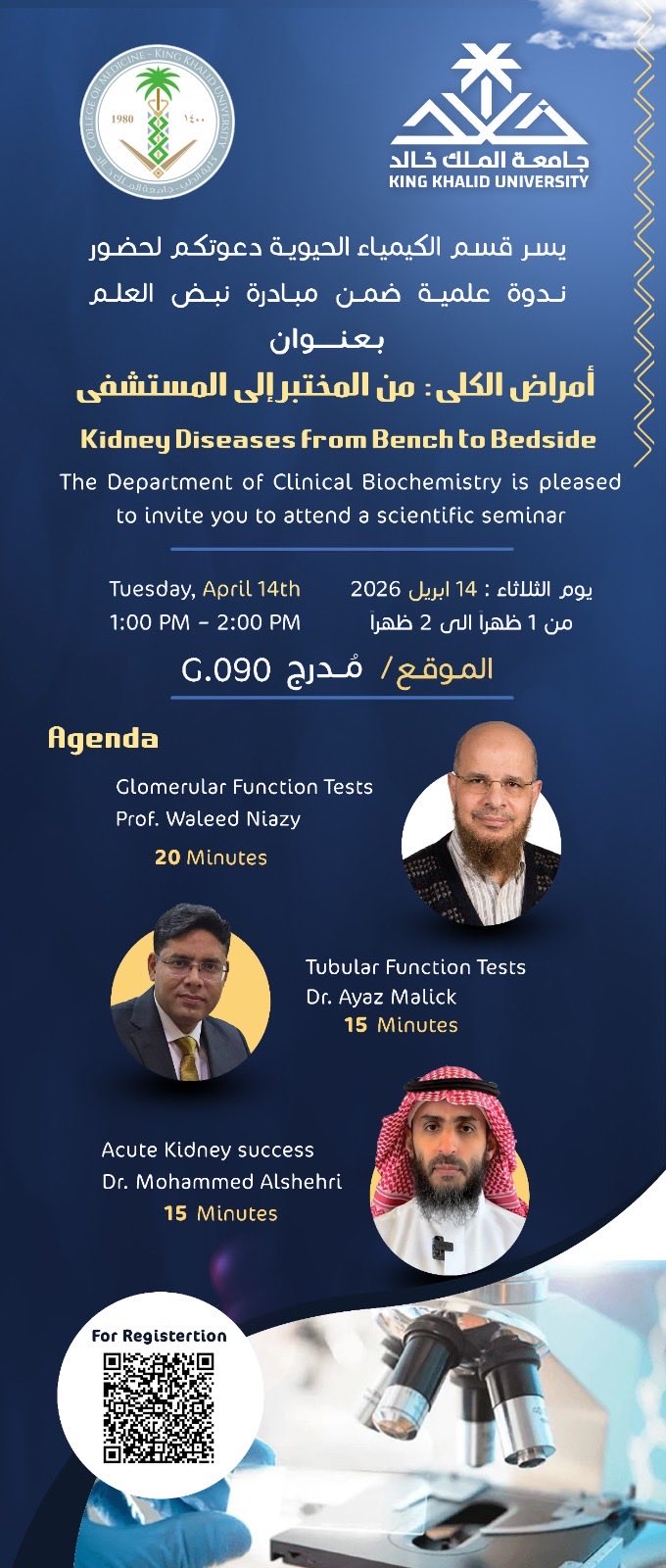
Archived seminar invitation: “Kidney Diseases from Bench to Bedside,” 14 April 2026, 1–2 p.m., Auditorium G.090.